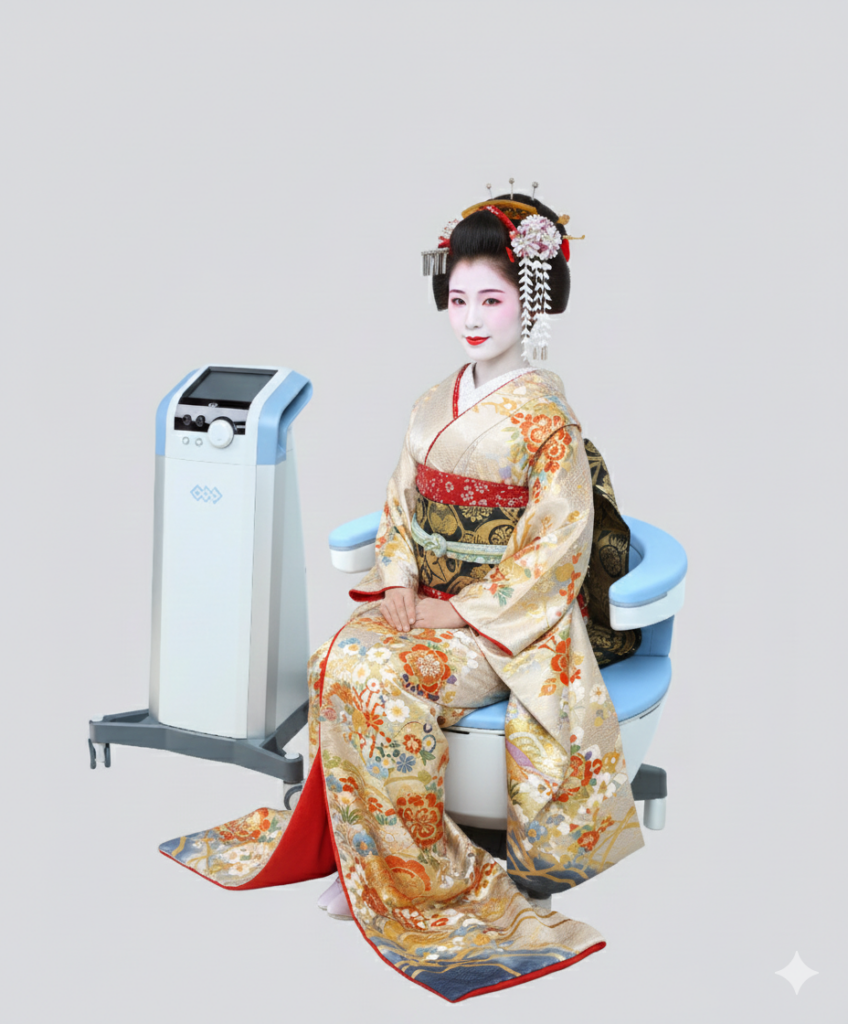
Transformational Intimate Experience
Important discoveries sometimes come at the most unexpected moments. The story of the Geisha chair is one of these discoveries, revealed during a deeply intimate moment.
Let me tell you this story.
At Chiswick Clinic, we introduced EMSella — an electromagnetic pelvic floor treatment — because it is evidence-based, non-invasive, and remarkably effective for women with incontinence, post-pregnancy weakness, or menopausal pelvic floor changes.
Before recommending any technology, we always try it ourselves.
So my wife Brigi, our senior therapist, decided to complete a full course of EMSella treatments. Six sessions. Twice a week. Fully clothed. Sitting comfortably, reading a book, as prescribed. Not because she had symptoms — she didn’t. No incontinence. No complaints. Pure professional curiosity, so she could genuinely explain the sensation and experience to our patients.
Nothing dramatic happened at the time. No fireworks. Just quiet sessions, appropriately completed.
Then, a few evenings later.
As married couples do, we were together. And in that moment, something was… different. The physical sensation of closeness was unmistakably stronger. Tighter. More controlled. More present. It wasn’t subtle, and it certainly wasn’t imagined. It was unmistakable.
I noticed immediately. I even said it — unfiltered, surprised, in the heat of the moment: “What just happened?”
It didn’t take long to realise where the explanation lay.
Where the “Geisha Chair” Name Came From
Later, lying side by side, talking — as couples do when something meaningful has just happened — I half-jokingly said: “We should call this the Geisha Chair.”
Like many people raised in Western culture, I carried a vague image of geishas as women trained to master their intimate muscles — an idea reinforced by popular culture, whispered myths, and, of course, Hollywood.
It felt like the perfect metaphor. Elegant. Mysterious. Evocative. A shorthand for refined control and intimate awareness.
But being a doctor — and a curious one — I did what I always do before putting words into public space.
I checked.
The Geisha Chair Myth — and the Surprise I Didn’t Expect
What I discovered genuinely surprised me.
The popular Western understanding of geishas is essentially wrong.
Japanese historians and former geishas have repeatedly stated that geishas were not sex workers, nor were they trained in sexual techniques. They were highly disciplined performers — musicians, dancers, conversationalists — whose value lay in artistry, etiquette and presence.
Even the film Memoirs of a Geisha, beautiful as it is, has been openly criticised in Japan for conflating geishas with courtesans (oiran), whose roles were entirely different. Several former geishas have spoken publicly about how uncomfortable they were with this portrayal — including Mineko Iwasaki, whose own memoirs and interviews criticised the film for presenting a Western fantasy rather than historical truth.
The famous “geisha balls”? A Western label. Not a geisha tradition.
In short, the story doesn’t stand.
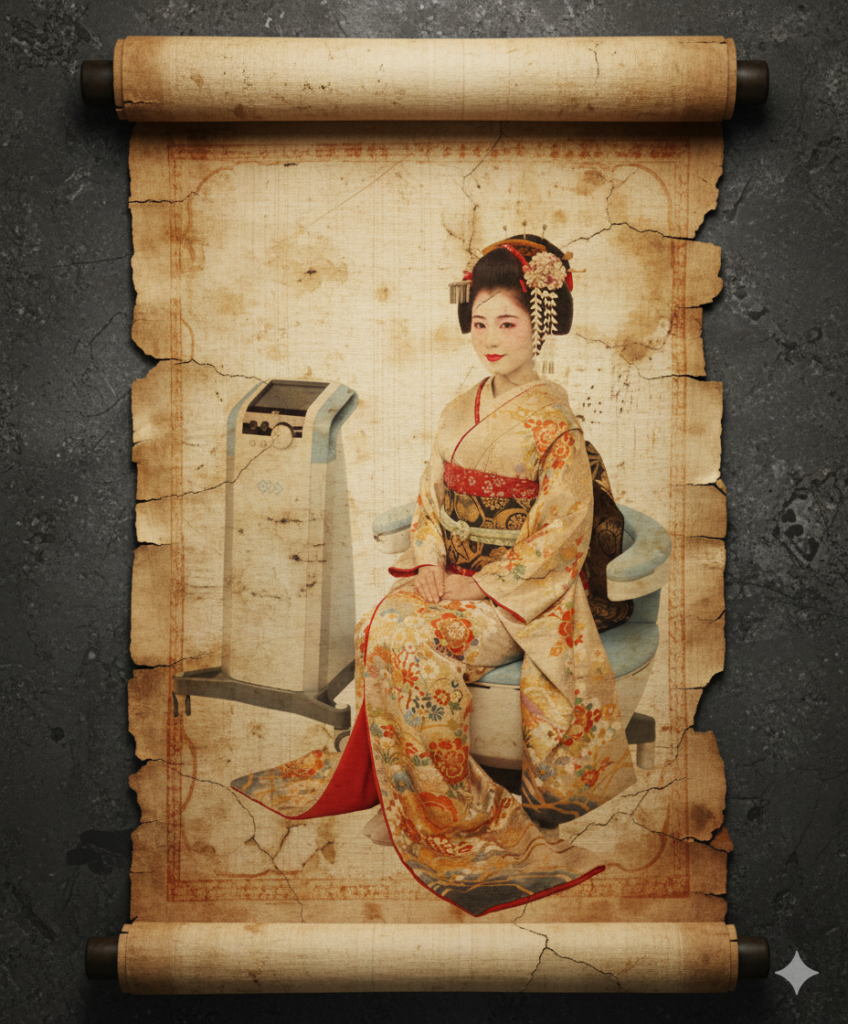
Why the Name Still Stayed With Me
And yet — the experience itself was undeniable.
So here is the honest truth: The Geisha Chair is a myth. The effect is not.
What Western culture mistakenly attributed to geishas—heightened control, strength, presence, and intimate confidence—is very real and achievable when the pelvic floor is activated correctly and trained.
EMSella doesn’t rely on fantasy or folklore. It uses focused electromagnetic energy to stimulate deep pelvic floor contractions—thousands in a single 28-minute session. Around 11,000 supramaximal contractions, far beyond what voluntary exercise can usually achieve.
You sit. Fully clothed. Twice a week. For three weeks.
That’s it.
More Than Intimacy — A Female Breakthrough
What matters just as much is this: This wasn’t only a breakthrough for me.
Brigi noticed meaningful improvements in menopause-related intimate symptoms — changes she had been dealing with before. The changes that many menopausal women struggle with have improved significantly as an unexpected side effect.
Deeply meaningful for her — and profoundly so for me.
Pelvic floor strength is not only about incontinence. It is about dignity. Confidence. Embodiment. Connection — with yourself and with your partner.
And too many women quietly accept decline as “normal”, simply because nobody talks about it openly.
A Final Thought
The Geisha Chair is not historically accurate. It is a story — a moment — a metaphor that emerged naturally from lived experience.
What is true is this: Strengthening the pelvic floor can be quietly transformative for a woman — and profoundly meaningful for a couple.
It doesn’t show on your face the way many aesthetic treatments do. It doesn’t show. But it is felt, lived, and experienced. It is life-changing.
If you’re curious, if something here resonates, if you feel this might be relevant to your own life or relationship, you can learn more about EMSella pelvic floor treatment at Chiswick Clinic and decide, calmly and privately, whether it’s right for you.
I wish every couple the chance to rediscover this kind of closeness.
Sometimes medicine does more than treat symptoms. Sometimes it brings people back together.
If you would like to explore whether EMSella is right for you, please contact Chiswick Clinic to discuss a complimentary trial session, if appropriate.